
Today I present you the Upthrust - the twin brother of the Spring pattern
As they say, it's the same thing only different.
What we do in trading is mainly pattern recognition.
One of the exercises I constantly do is collecting examples and checking the charts for my pattern. Identifying support and resistance lines. What is the trend? Is there such one at all? Where is the price in relation to the EMAs?
Spotting my entry. Do I have a compelling candlestick formation as my trigger? Entering here, then where to exit, and how to manage the trade.
It is a lot of stuff to think about. Technical analysis is rich in explanations and ideas. Add the fundamentals and it becomes even more interesting.
At some point in time using the Al Brooks style of price action trading I was taking too many trades. The problem is not with Al's teachings - they are great. I just had too many analyses embedded in my brain. I had all that knowledge and I wanted to utilize it. Every person who is committed to self-mastery and improvement knows that feeling—leaving no skill unused or knowledge unapplied.
So why not apply it, take every opportunity, and become an ultra-successful trader in no time?
Well, trading is nothing, but logical at times. The simpler it is - the better it will be. At times it feels the more counterintuitive you trade, the better results you have.
Less is more!
Even if you see me run Stochastics on my charts, it is there to show me divergences. Also, I have it constantly so I can train my eyes to see where the price is overextended or losing momentum. Lane's Stochastic is great in channeling markets and complete nonsense in trending ones. No indicator works in all markets. I want to train my eyes, and my brain to spot that, not some derivative of price. All of the indicators are some mathematical formulas taking inputs from the price.
What works is training your eyes to see and your gut to feel if it's right.
That happens through repetition.
Through the right practice.
Trading one pattern.
Or just a few.
Mastering it.
How?
Make this Upthrust pattern yours
Knowing all nuances of it. Making it your project. Your thesis. Your doctorate if you wish. Your journey.
Get yourself familiar with it. Observe it. Know what it looks like in different instruments. Knowing how it behaves in relation to volume.
Seeing thousands of patterns. Being able to tell an excellent one from a mediocre one. Then having the patience to trade only the best. Over and over again.
When trading becomes boring. When you focus on the process of finding your patterns and executing perfect trades. When you don't think that much or at all of the results -
they will come. It's why it's so counterintuitive.
Let's go back to where we started - Upthrust pattern recognition
Check my drawing illustrating an Upthrust which is the mirror image of my lovely Spring:


What you see schematically in my hand drawing:
- Support turns resistance
- Then prices 'kisses' it once
- Tries to continue in the direction of the longer term trend, but loses momentun
- Takes the previous high (traps all people attempting a breakout) and reverses
- On a close below that level, typically in the form of some good entry bar - I enter
Above part as you see is fairly mechanical.
Trade discretionary the Upthrust
Add some volume validation or non-validation. Get directional bias from the higher timeframes. Check the Stochastic for some divergence - and it becomes discretionary.
The more ticks in a box - the better the odds.
Now you saw the theory drawn on a sheet of paper. Your job is to find that, recognize it and capitalize on the opportunity on a large enough batch of trades so you
can play out your edge. Remember what Marc Douglas used to say? No one knows the result of a single trade. You need a batch of trades.
Below is a chart of NASDAQ illustrating perfectly what I am hunting for:

Did you recognize it?
Did you see the falling triangle that broke down? Then support turned resistance and this beautiful Outside bar was the predecessor of this big down move.
It was not the bar itself that made it, but the mass of traders that was trapped on the wrong side at the London open.
Another 2 Upthrust examples

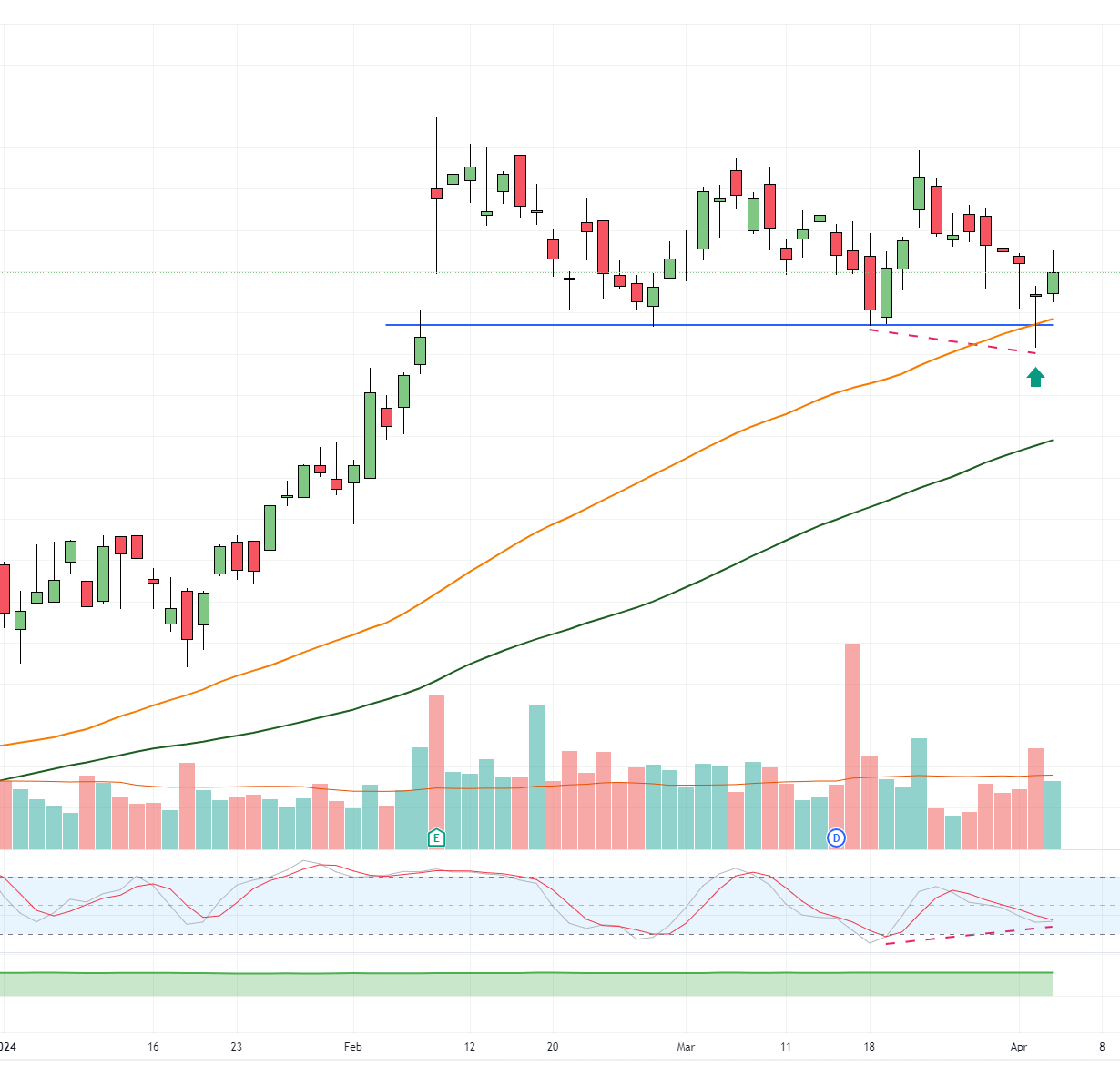
The first is a clear AB=CD which is a fairly tight setup. The second is looser, and appears as a fakeout out of consolidation.
Using bars instead of candles sometimes makes it much clearer to see. I've found this setup called a 'swing trap' by some traders.
Many more micro versions of the Upthrust probably will be tradeable and visible on the lower timeframes. Have a look even here - try to find them.
But please don't go that naivelly as the noise especially in forex might just destroy you, unless you are not used to a very low hit rate.
Upthrust Variation
Our job as traders, as masters of our setup - is to recognize the variations. In my case not always support turns resistance.
Sometimes when the trend is very strong you have no clear line of support/resistance where is your entry zone. You just wait for the previous high or low to be taken.

Now that you know in general what the Upthrust is. From the previous post, you should know what the Spring is.
Find many charts - and look for all Springs in an uptrend and all Upthrusts in a downtrend.
Find enough examples, and group them. Think about which are A+ setups, and which are mediocre ones.
Over time you will start seeing them.
As a Spring Hunter, my job is to take all Springs in an uptrend and sell all Uptrhursts that I see in a downtrend.
In the next post, I will show you why.
Yours truly,
The Spring Hunter

Hello!
This was the best article that I’ve ever read…you explain it beautifully. I’ve gone to a chart and looked for some springs and upthrusts…and here emerged some questions:
1. How do you know when you should have previous support becomes resistance. I mean do you somehow quantify it or is it just gut feel?
2. What if the spring does not only come back once, but for examples comes back again and runs the spring? What do you do then? Do you then pass the setup or do you say: “That’s no spring anymore”
…for example when you have a spring, goes back up, runs back down andgoes down below the spring and then reverses…
3. Can it be “any resistance” that turns into support can it be any old resistance on a chart (for example not the last high, but maybe the high before the last high)
4. Would you trade the spring when you would have your resistance turning into support, then it moves up and makes a new high and then it pulls back, kisses a second time (goes lower than the first pullback or the same level or a bit higher…just comes back a second time), moves back up and then goes back down and makes the spring…do you then say: “that’s not a spring anymore” or do you say: “yep. that’s one. i’ll take it”.
I hope I haven’t wrote it here so complicated that nobody understands it….but I cannot draw here in the comment section of the blog, so I had to put it into words. I hope that you can help me here. If it would be easier for you to make a call or something idk. then we could also do that 🙂 whatever works best for you
Thank you for the blog! Great thing! And your first YouTube video was awesome
Hi John,
I think you’d find this useful. Created it for you and the rest readers who had questions:
Deep dive into the Wyckoff Spring and Upthrust + Video at the end
Hope it covers them all.
Pingback: Deep dive Wyckoff Spring and Upthrust + Video in the end
Having read your posts. I believed you have given your readers valuable information.